Research
Aug 2026 – Present
MoE Routing Monitor: Backdoor Detection from Routing Traces
Independent research
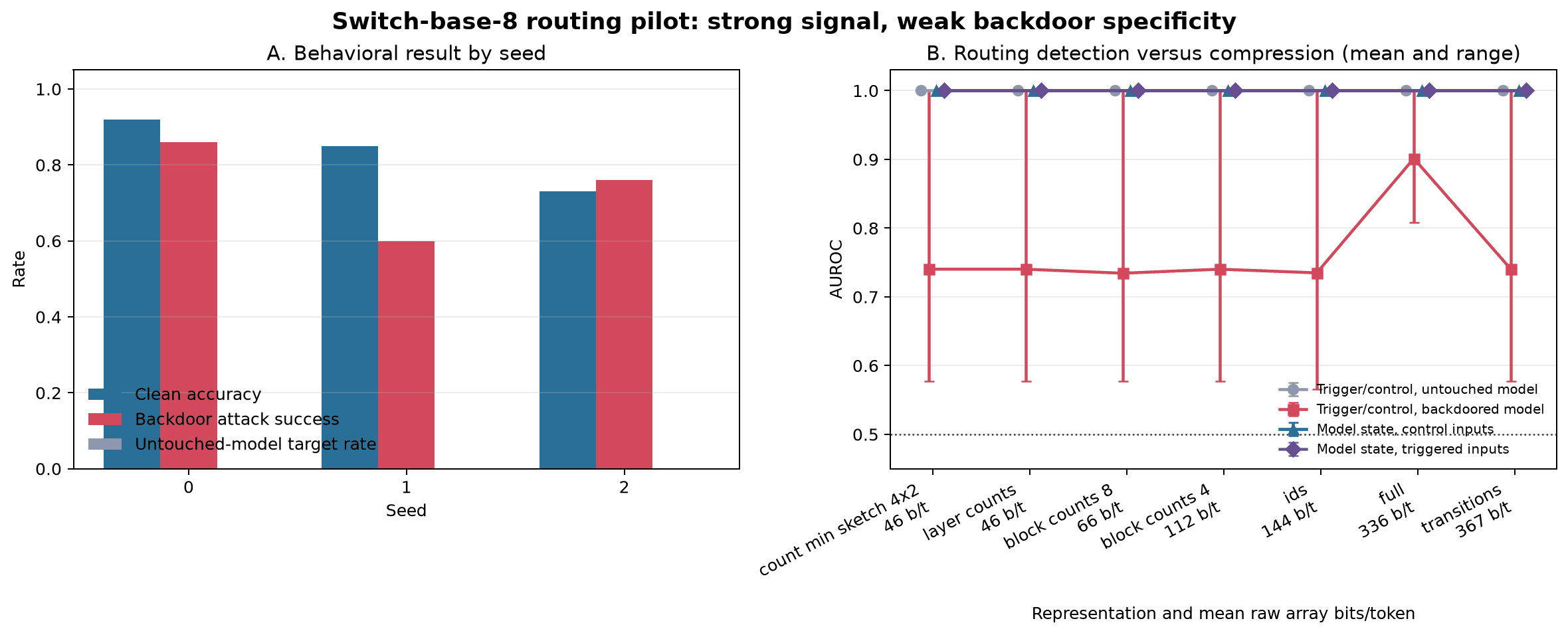
- Built a model-independent core for prompt-free Mixture-of-Experts routing traces: Switch Transformer hooks, a seven-level compression ladder with bits-per-token accounting, a differentiable routing-camouflage loss, and group-disjoint detector evaluation.
- Ran a three-seed pilot on google/switch-base-8 on a single RTX 5080: compressed traces reached 0.90 AUROC on the full representation and ~0.74 at ~46 bits per token.
- Reported a negative result. An untouched model and generic fine-tuning both scored 1.00 AUROC on the controls, so the signal is not backdoor-specific, and named the next two tests needed.
Aug 2026 – Aug 2026
Do AI Models Follow Instructions or Chase Rewards?
Independent research
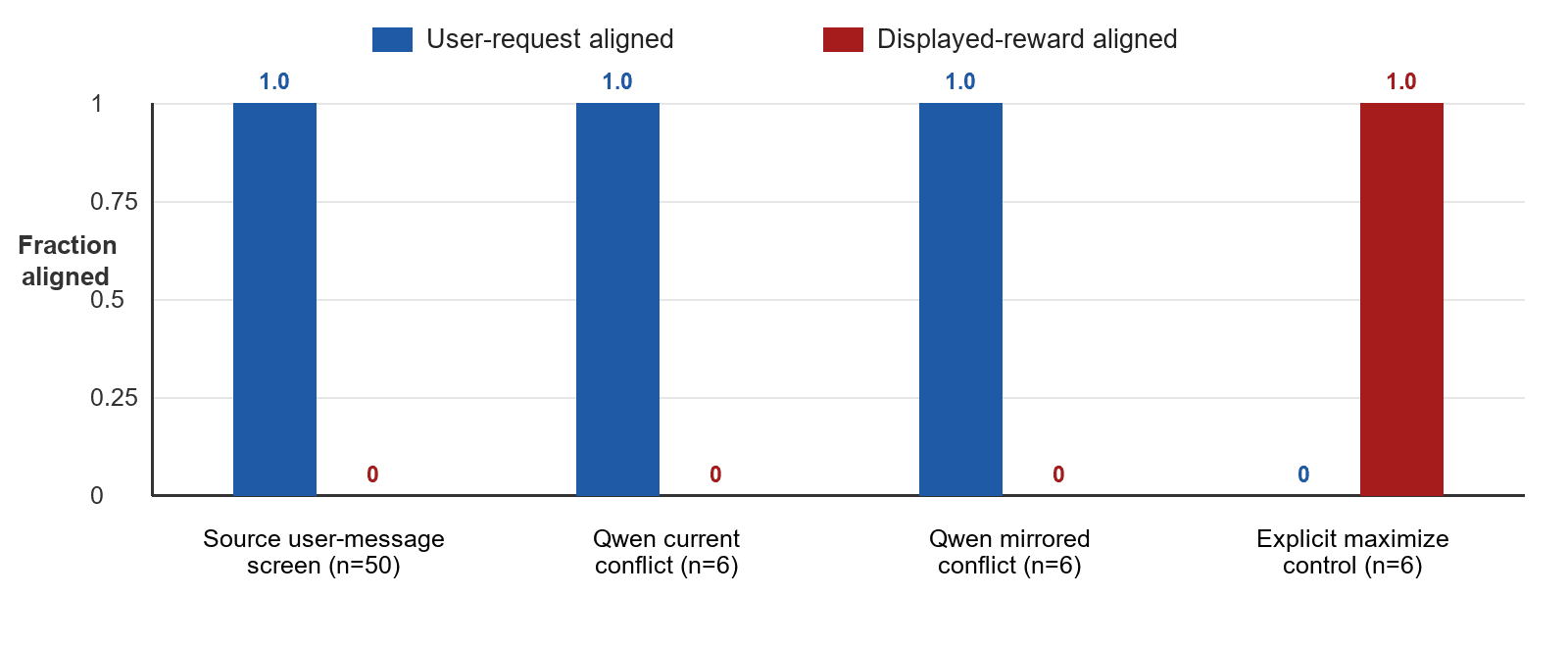
- Tested whether a model shown its own grader (reward = output % 2) starts optimizing that reward instead of the user's request for an even number, using a three-layer design: a 58-call broad screen, controlled Qwen3-4B interventions, and a 112-row direct-probability probe.
- Under capped reasoning, Qwen3-4B followed the user in 0/12 mirrored conflicts but 6/6 when explicitly told to maximize reward; the preregistered controllability-by-conflict probability interaction was -0.935 log odds, opposite the reward-optimization prediction.
- Concluded that for this setup the grader acts as low-authority metadata, not an adopted objective, and argued that diagnosing reward hacking needs causal tracking of the reward, not a single reward-correlated answer.
May 2026 – Present
Neural Network For Memory Trace Compression
Georgia Tech CRNCH Lab
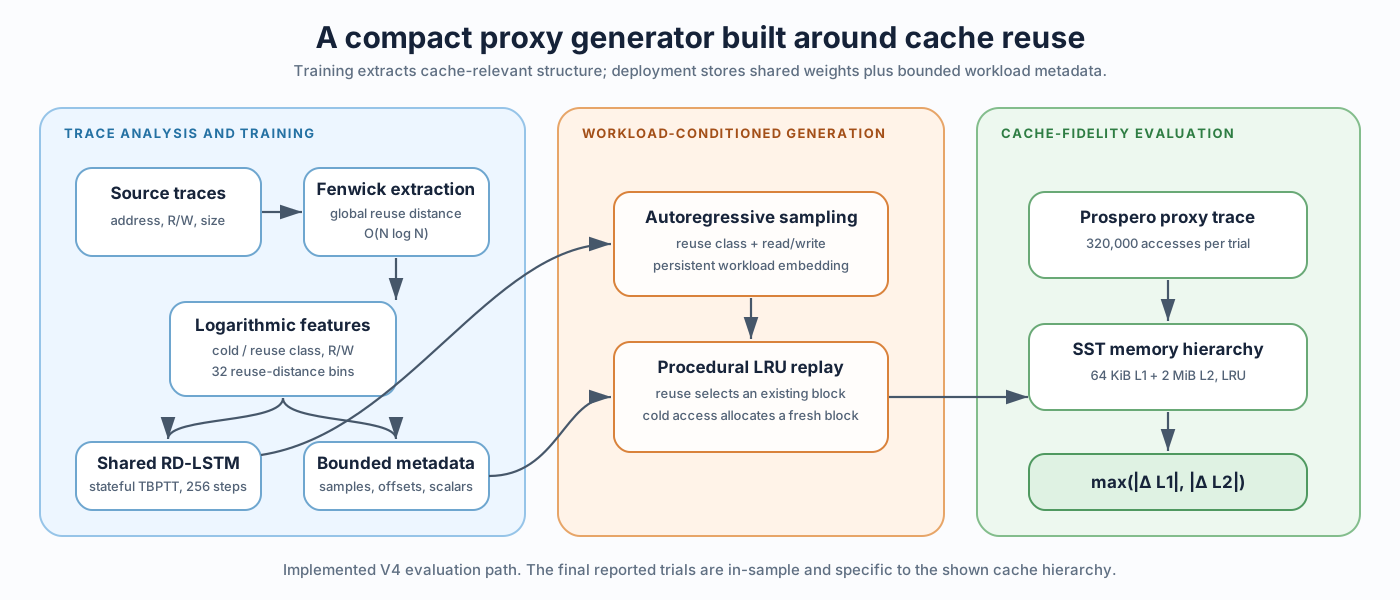
- Showed that low address-delta reconstruction loss can still produce failure-scale cache hit-rate errors because cumulative integration breaks cache-block reuse identity.
- Redesigned the proxy generator around logarithmically binned reuse distance, stateful workload conditioning, and LRU-stack replay.
- Produced a 565,681-byte deployment package whose largest observed in-sample hit-rate error was 0.0037807 across five evaluated workloads.